Friday, 15 April 2016
What I have learned from "Invitations to Joy" by Jean Little
In my Children’s Literature class, we have studied “Invitations to Joy” by Jean Little. According to Jean Little, reading is the joy. She thinks that writing should also be joyful for children and writer. Jean Little thinks writers should be responsible for themselves and their works. The writer should try their best to writers the story instead of "playing famous". Jean Little also thinks as writers, their job is to write about both good and bad side of our lives. Not just paying too much attention to the public's standard for children's books. Sometimes writers play safe to meet the public's standard for children's books. From their books, children learn our world in a narrow way. They don't understand emotions such as loneliness, fear, sadness are also part of our lives. Also, parents, teachers, and librarians make decisions on the books for children to read. However, it could limit children's imaginations and influence children's ability to make decisions.

Leslie's essay from A Bridge to Terabithia
Here's Leslie's essay from A Bridge to Terabithia :
"I'm moving gently forward,
over the wild and beautiful,
unexplored world below me.
I'm floating in silence,
and breaking it up
with the sound of my breath.
Above me, there's nothing
but shimmery light,
the place where I've come from,
and will go back to
when I am done here.
I'm diving.
I'm a scuba diver.
I'm going deeper past
the wrinkled rocks and dark seaweed
toward a deep blueness
where a school of silver fish waits.
As I swim through the water,
bubbles burst from me,
wobbling like little jellyfish
as they rise.
I check my air.
I don't have as much time
as I need to see everything,
but that is what makes it so special."
(Source: http://www.script-o-rama.com/movie_scripts/b/bridge-to-terabithia-script.transcript.html)
It is a very beautiful piece and I think it is worth a share. In the film "A Bridge to Terabithia", Leslie told Jess that she had never been to a diving; all of these experiences came from her imagination. "A Bridge to Terabithia" really establish the power of imagination. This essay foreshadows Leslie's death as it says "I don't have as much time as I need to see everything," and "Above me, there's nothing but shimmery light, the place where I've come from, and will go back to when I am done here."
I like her essay lot. Especially when I watch the film again, after I already knew Leslie's death in the later part of the film. I was really sad when I watch Leslie presenting her essay in class. My first thought was "why it has to be her?" and my second thought was"of course it can be her, it can be anyone." Death and unfortunate happen in our lives. Knowing that Leslie's death is related to the water. I deeply hope that Leslie wasn't that suffering as she approaching the end of her life.
Review of “The Orphan Boy” written by Tololwa M. Mollel
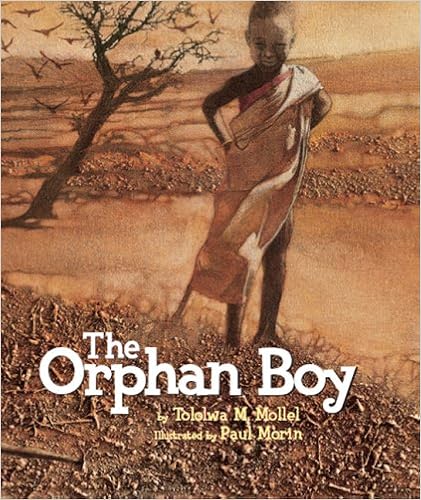
“The Orphan Boy” written by Tololwa M. Mollel was one of the books we discussed in class. The genre of “The orphan boy” is fantasy but it also feels like a folktale. In “The Orphan Boy”, the antagonist is the protagonist himself. The protagonist is the old man. An orphan boy came to him and delighted his life. Soon the old man became curious to know the secrets of the orphan boy. He was struggling because he did not want to break the trust between him and the orphan boy. In this conflict, the old man’s desire won. He followed the boy and found out the orphan boy was the star. As the result of this conflict, the orphan boy returned to his star and the old man remained in his regents. He learned that he should not break his promise and he should not let his desire controls his decisions.
The media of the illustrations looked like oil paints or acrylic to me. I think this choice of media was because the illustrator wanted to establish the historical feeling of this particular story. The illustrations interpret the text very well. The illustrations are detailed and decorated the text well, it expand some feelings that the text did not mention such as the struggling between the old man and his desire and the sacrosanctity of the orphan boy. The colours of these illustrations also guide the readers through the story. The illustrations were bright and warm in the beginning then they turned to dark and cold in the climax when old man struggling with his desire, and then the colours became bright again in the ending. Colour always helps readers, especially young readers to understand the progress of a story.
A thought about "The Red Tree" written by Shaun Tan
"The Red Tree" written by Shaun Tan was one of the “difficult stories” we have studied in Children’s Literature. It is a difficult story because the theme of this story is about children’s depression and the illustration of this book is not quite suitable for kids. When we read “The Red Tree” in class, we were surprised about these illustrations in the book. The illustrations are very dark, complex and depressed. We wondered why such illustration could be used in a children’s book. Later when we were discussing it, we found that the book is not only about depression or trying to make children depressed. It is also telling children and adult readers that children’s depression exists and horrible things will pass no matter how bad your current situations are. The benefit of publishing this kind of story for children is letting them know that bad things happen in our life are normal. It is normal to feel sadness and depressed. And those moods and times will pass.
Not just about the depression
When I was still in high school, Shaun Tan’s animated short film "The Lost Thing" amazed me. My decision to study animation at Seneca was more or less affected by "The Lost Thing" and many other terrific animations and feature films that I enjoyed and was motivated by.
Shaun Tan’s short film "The Lost Thing" was based on his book of the same name. I knew it, but I had never gotten a chance to read the book itself. I recognized Shaun Tan when I read his book "The Red Tree" in class. I couldn't say which one is better. I like "The Red Tree" as much as I like "The Lost Thing". They are two different stories yet similar in many ways. Both of them happen in an industrialized world; people were numb and depressed in there. They lost their curiosity and stopped noticing interesting things in their lives. Both stories were about looking for answers about who you are meant to be and where you belong. My favorite line from "The Red Tree" was "Suddenly there it is, right in front of you bright and vivid quietly waiting,", and then the red leaf grew to a red tree. The red tree symbolizes hope to me. This line also reminded me a scene in "The Lost Thing". When the gate opens, a dramatic, bizarre and colourful world is suddenly revealed and the lost thing find the place where it belongs. That was an enormous difference compared the depressed and ordinary world. Similarly, in "The Red Tree", the little girl saw the red tree grow up and she was no longer depressed. These endings also brought up ideas that besides depression, feeling lost and confusion; there is also happiness, hope and excitement in our life.
I enjoyed reading and watching Shaun Tan's works. I like how detailed and entertaining his artwork were, such as the trail of red leafs in every page and Chinese newspaper prints in the background. I also like how Shaun Tan built up the whole story with depression but gave us such warm contrast by the end.
Thursday, 25 February 2016
Childhood memories
I was born and grew up in a small city called
Fuqing, in southern China. I spend most of my childhood there. In my memories,
it was small, messy, boring and stiflingly hot. It was not special at all.
The only special thing that I can remember was a
temple in east town, a small traditional Chinese architecture in red and yellow
colours. This temple was such a mystery to me since I was a child. East town
has been an Economic and Technological Development Zone since I can remember.
This old temple really stood out in that area. I was curious about its
existence. In my memories, I had never seen a Taoist or a monk in that
neighborhood. I had never gotten a chance to enter the temple. The doors were
always closed and locked. For years, I hadn't had any idea whether it was a
Taoist temple or a Buddhist temple. I had even doubted that it might had been
just a very expensive decoration of the park. My mother told me not to be
bothered about it, because the temple was not for the public anyway.
Until one day I heard this one story from my uncle.
We were in the car, just passing by the temple. My uncle casually told me a
folk tale of Cha Ting. Cha Ting is the name of the temple. It has been known
for a long time. People said that there is a god living in that temple and the
god is protecting Cha Ting.
Cha Ting sits on the riverside. The river was
forced to go around the temple because of the immortal god's protection. Cha
Ting survived every natural and human disaster. Typhoons and floods had never
harmed Cha Ting. A farmer even said he saw Cha Ting floating in the air when
the flood came about. Cha Ting is untouchable. People would be cursed if they
attempted to damage Cha Ting. During the Cultural Revolution, local Red Guards
evacuated Taoists and tried to destroy the temple. Many of them fell sick at
the same time. Local people said they offended the immortal god. The Red Guards
were afraid and then they gave up their plan. Cha Ting survived that disaster
unlike many other cultural relics. Back in the 90's, east town became
Development Zone. At the beginning, local government intended to demolish Cha
Ting. However, it ended up safe somehow.
An immortal god lives 15 minutes away from my home!
Ten year old-me was so excited, but she pretended to be calm and said
proudly," I knew there must be something special about Cha Ting." I
still love the story. It really made me feel happy about knowing such
incredible "history" and involving in this specialness.
Subscribe to:
Posts (Atom)